
Anna Gibson’s Fast Track to the Olympics: A Crash Course in Skimo

N (Nate Berenson): Let’s start at the beginning. How did we get here? Because this is a pretty incredible story. You’ve been on such a wild journey to this point.
A (Anna Gibson): The Olympic story really begins with what’s been jokingly called “the proposal” from my teammate, Cam Smith — because he’s the one who recruited me into skimo in the first place.
I’ve known Cam for four or five years now. He’s been tearing it up in trail running and ski mountaineering, and he’s been racing on the Skimo World Cup since 2017, so he’s quite senior and experienced. He approached me in June at a trail race that we were both at and basically explained to me that the U.S. was on the cusp of making the Olympics. We were one point behind Canada, and we simply had to beat them at one race in December — that was the qualification mechanism.
Then he explained why he thought I should join the team and try. I could just see the excitement in his eyes and could tell how much this meant to him because this is a dream he’s had for a long time.
This wasn’t the first time that skimo had crossed my mind as something to compete in. A lot of people have brought it up to me over the course of my life — just as an endurance athlete. Growing up being a skier, racing Nordic, racing downhill — it seems to make a lot of sense to a lot of people that that’s something I would get into, including me. So it didn’t feel super out of the blue.
It felt like a turning point where I could either decide to take it one step further and start competing as soon as possible — go through the skimo crash course — or I could decide to do what I’ve done in the past, which is put it away in my mind and leave it for later. And obviously I decided to go for it.
In large part because of Cam’s excitement, and just knowing that I could give six to eight months of my life dedicated to this goal — and it would make dreams come true for more than just the two of us, but also all these people in the U.S. who have been trying to build the sport up into what it is now.
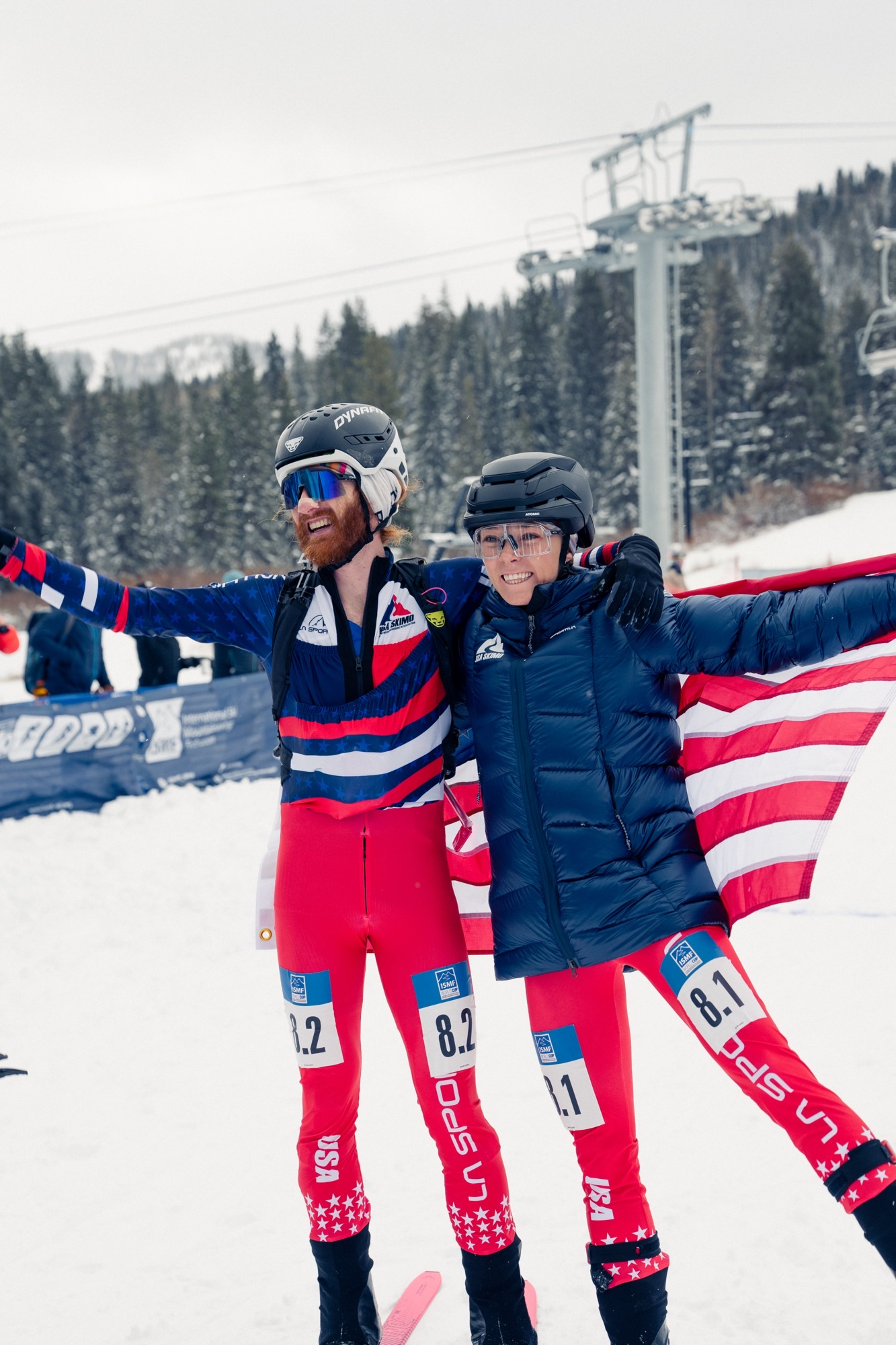
N: Big shoutout to Cam — and also to Lynn, his wife, right?
A: Big shout out to Cam, and also a big shout out to Lynn, Cam’s wife — because she’s the one who ultimately pushed him to ask me. He chickened out a handful of times because he was afraid to ask me to add this massive thing to my life in a very last-minute way, and Lynn was just on him about it: “You’ve got to do it.”
N: For the people that don’t know, what is skimo?
A: Skimo can look a lot of different ways. It’s one of the sports that has a very wide range in formats. Things people might be familiar with are races like the Grand Traverse in Colorado, or Pierra Menta — a big famous race over in Europe.
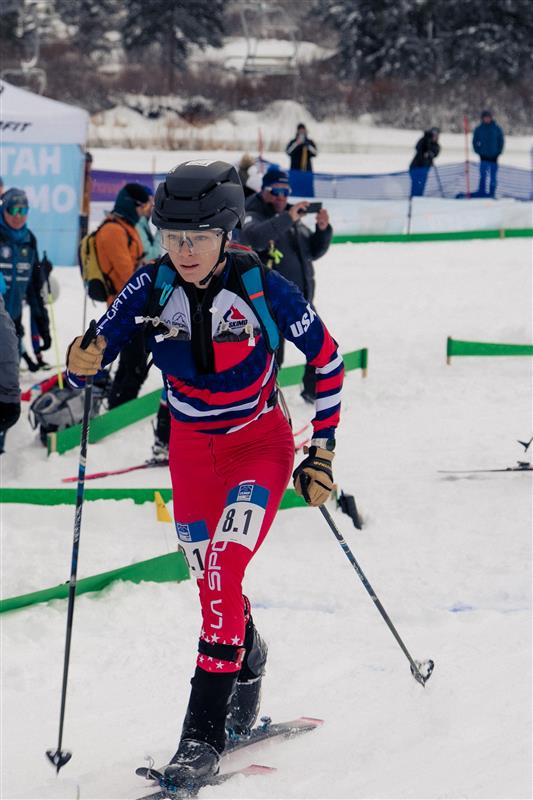
The Olympic disciplines are very different from that — they’re very sprint-oriented, short races. But it’s essentially a combination of some of the hardest parts of Nordic skiing mashed up with alpine ski racing. You’re doing a kind of classic ski motion on the way up with skins, and then sometimes there’s a boot pack section. In the mixed relay — which is part of the Olympics — you’ll shoulder your skis for a section, then you’re back on skins.
Then you race down a course through GS gates that sometimes has jumps and rollers and banked turns. It’s almost like skimo meets skiercross.
There are four disciplines on the Skimo World Cup circuit, and they chose two of those to add to the Olympics. So it’s a very limited sampling of what the sport looks like with a very small quota of athletes. There are only 18 men and 18 women included in the entire event — in the whole world.
N: Who are the dominant countries in the sport?
A: I think it’s pretty to be expected if you’re familiar with skimo at all — it’s a very European-centric sport. The top countries are Switzerland, Spain, Italy, France.
And then, because of how the whole ranking and qualification works, they’re trying to have countries from every continent. That’s why we were battling Canada to make the Olympics. They’re not included because we beat them — because there was only one North American slot for qualifying.
Then there will be a team from Australia because they’re the only nation in Oceania that can qualify and has a skimo federation. So it’ll be a smattering of international nations, but the top names historically have mostly been from Europe.
N: There’s so much pressure around the Olympics and the lead-up. How do you stay above it and stay focused?
A: This is sort of a two-part thing for me.
There’s the time now in the lead-up — knowing we’ve qualified for the Olympics and it’s coming down the line pretty quickly, but it’s not here quite yet and I’m still at home. I’ve had to learn how to balance all the demands. There are logistical pieces, interviews, and cool opportunities coming up, and figuring out how to balance those with training has been an interesting journey over the last couple of weeks.
But the mindset overall has been honestly incredible. I have zero complaints about adjusting to it. It’s the coolest thing ever as an athlete to know you’ve made it to the highest level and you’re going to be on the world stage — and then also feel the excitement from this whole community.
Being in Jackson for the last month has been so fun because everywhere I go, there are people who have known me since I was a baby and are rooting for me and super excited. That part has made it feel like it’s much greater than just about me — which makes the Olympics feel different than any other sport accomplishment. People buy into the Olympics like no other.
There’s this sense of the community having raised me, and it being a group effort rather than a me thing. I’ve really been enjoying that process — just soaking up all that energy.
N: Do you feel pressure about the outcome when you get there?
A: The Olympics is interesting because knowing that being there is an accomplishment in and of itself makes the whole thing feel different. You’re not as worried about the outcome — at least I’m not.
I’m sure people who are going in with expectations to medal have a completely different mindset. But for us, it felt like such a push just to make it. And it’s been so last minute for me to jump on board with the process of trying to qualify that just waking up in the morning and knowing I’m going to the Olympics has been a total pinch-me moment.
I don’t feel that much pressure around the actual race. I’m obviously competitive and I’ll try as hard as I can, and I know we’re capable of big things — we’re definitely going to be in the conversation. But I feel a sense of accomplishment before even setting foot on the start line, so it doesn’t feel like there’s that much pressure.
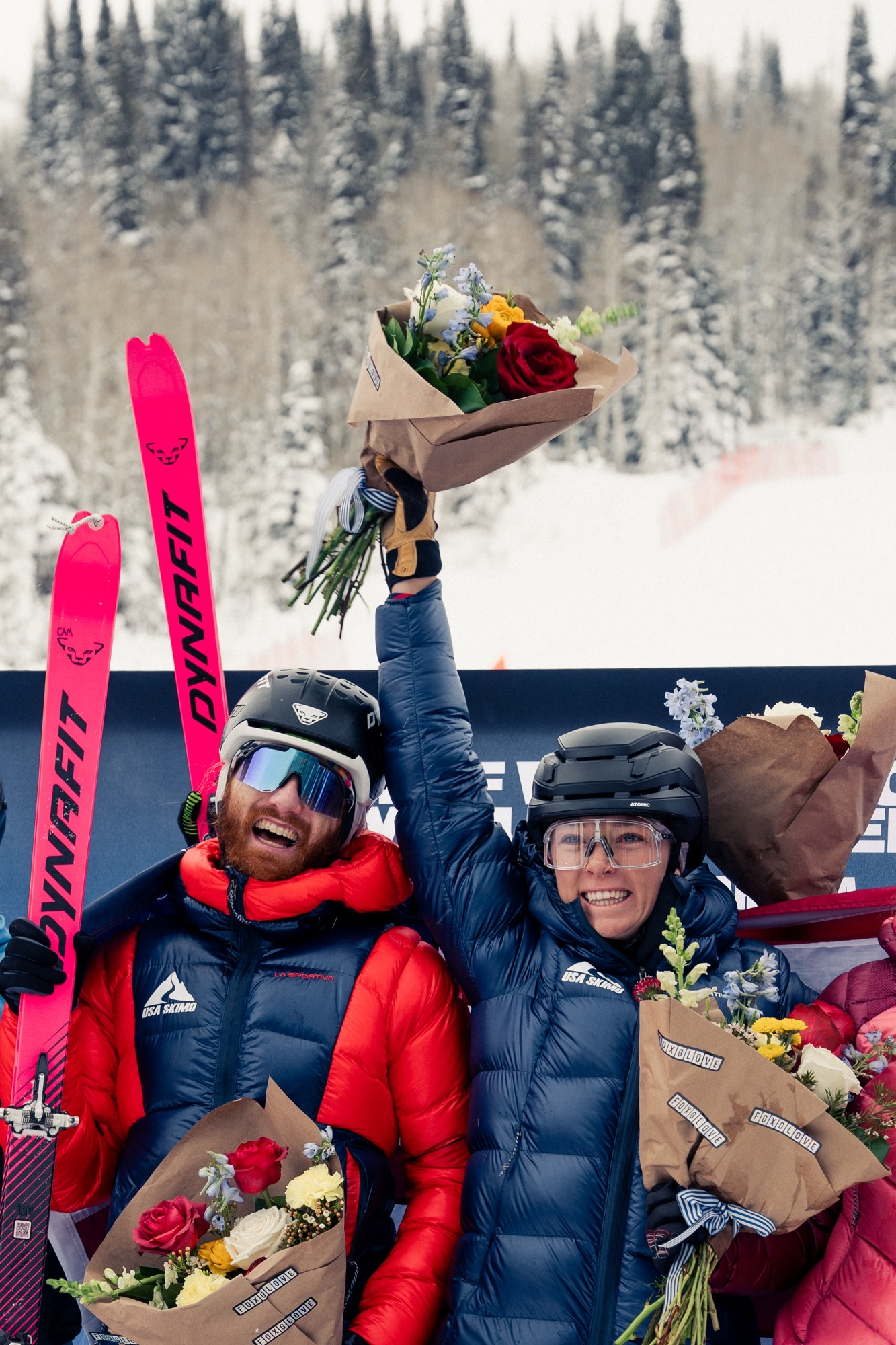
N: What are your goals? Do you have one big goal, or a few boxes to check?
A: I’ve learned that as an athlete, I’m always going to do my best when I don’t really have an outcome goal.
I showed up at trail world championships and did not have the thought of a medal inside my head — even though I knew objectively that I could compete for it on my best day. Same with other big performances I’ve ever had. In college, breaking an NCAA record with my relay team, we never discussed beforehand that that was what we were setting out to do.
When I look back, my best performances were when I was showing up excited about the experience, loose, having a good time — bringing joyful energy instead of being worried about the outcome.
So I honestly don’t have a goal in terms of medaling. I know Cam and I are capable — if we have our best day — to perform really well and compete with the best in the world. But I’m more focused on the experience and the process.
Skimo is new to me, and I want to show up and nail all of my transitions in the race and not have that skill hold me back. I want to show up healthy and mentally ready. I’m focused on physical preparation to put us in the best position possible, rather than what could happen if we show up at our best.
N: Has that mindset always been natural for you, or has it developed over time?
A: I don’t think it was a super conscious choice to shift my mindset, but looking back, I can see my college years as a time when I was really trying to perform and was all about results.
As I became a professional, I made choices that steered me away from that. I surrounded myself with a coach who’s completely unconditional and does not care if I get first — he’ll coach me until I say I don’t want to be coached anymore. Performance doesn’t matter as long as I’m trying my best, I’m a good person, and I have good sportsmanship.
I also feel unconditional support from the brands I work with. I have no pressure from them to perform — they’re bought into the process I’m on and who I am as a person.
A lot of athletes struggle with pressure imposed by school, family, coaches, other people. I’ve made a conscious effort to only surround myself with people who feel truly unconditional. Because I don’t put pressure on myself — so if it’s not coming from anywhere around me, it doesn’t exist.
N: That qualifying race was do-or-die. What was your mindset that morning?
A: That’s probably the most commonly asked question I’ve gotten about the qualifying race that Cam and I did on December 6th — the one that earned us the Olympic spot.
We lined up and it was do-or-die: you either beat Canada and you become an Olympian, or you don’t. From the outside, that would look like the most pressure-filled situation you could possibly be in.
For some reason, I felt so loose and joyful that morning. It wasn’t stressful at all. I was nervous — I’m always a little nervous — especially with a teammate where I don’t want to let them down.
But to me, it was about the team behind us and the support system. I knew we were basically the pawns being played as the last move. There was a whole string of hard work from other people, investment of time, money, and energy that gave us the opportunity to race.
Ultimately, if we didn’t make it, it wouldn’t be because the two of us failed in a silo. It would be because none of the pieces fell into place for the U.S. to be in a position to qualify.
USA Skimo did a really good job not putting pressure on us. They were like, “Hey, it’s the first time it’s been in the Olympics. If we don’t go, we’ll try again in four years. It’s okay.”
N: Do you draw inspiration from specific people?
A: One easy place to turn is other Team USA athletes I’ve looked up to my entire life — athletes I watched on TV who I’m suddenly going to be standing shoulder to shoulder with at the Olympics.
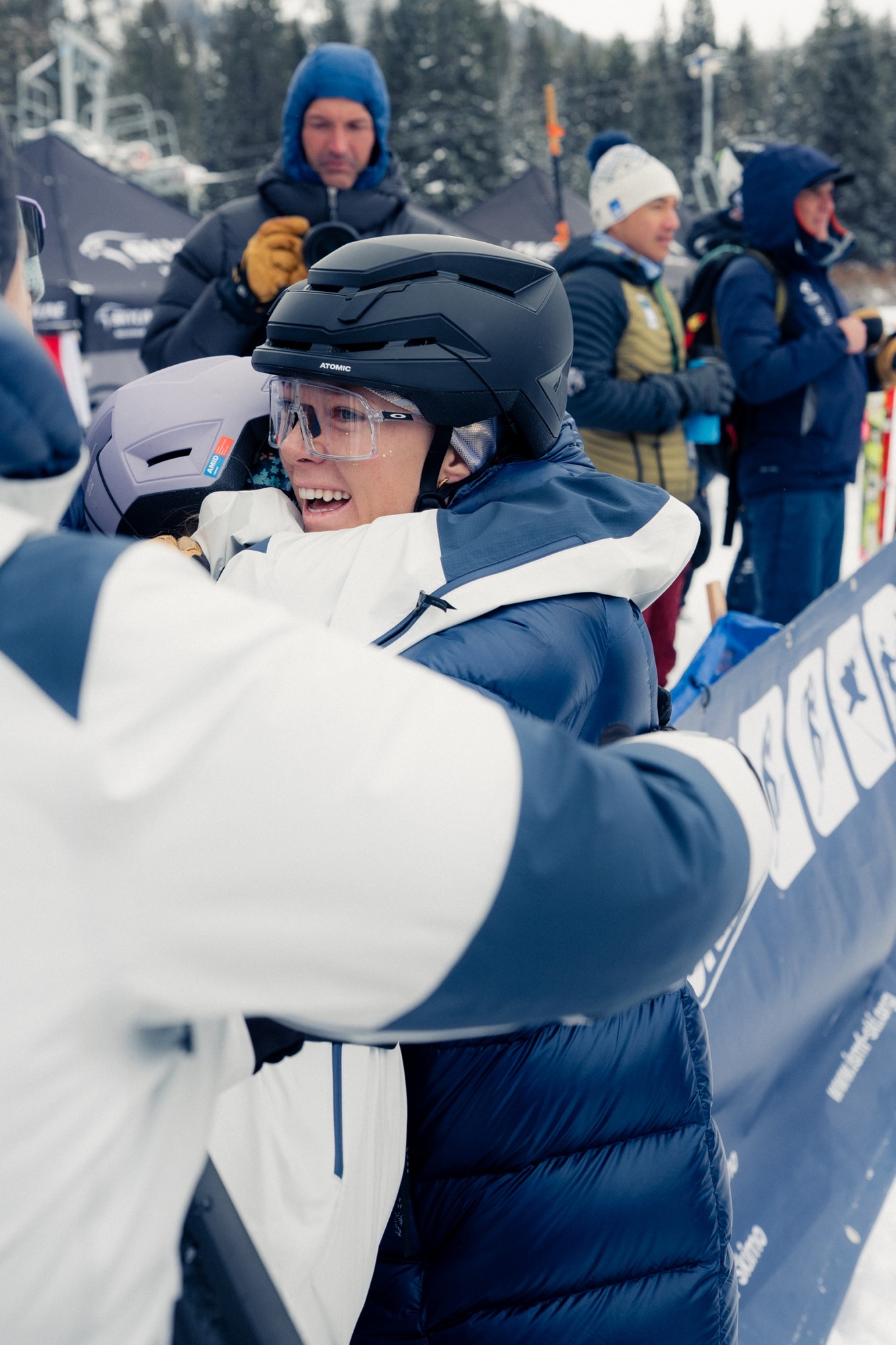
Jesse Diggins is one. She had a big impact on me as a kid, and still to this day seeing her winning races in peak form with a huge smile, glitter everywhere — she’s the vision of what I want to be when I’m that far into my career. I hope I still have that same energy.
I’ve gotten to know her a bit over the last couple years and she’s a wonderful person. I admire her even more now.
And then there’s a whole other class of athletes outside my sports where I admire people who are system defiers — who redefine how sports can be done. Lachlan Morton is a great example. He charted his own path in cycling, and at first the industry was unsure. Then they realized how talented he is and how many people he inspires, and everyone jumped on board.
I’ve seen multiple athletes do that. It’s inspired me to follow curiosity and not put limits on what sports I do or what I try. It’s opened up a ton of doors — I’m literally going to the Olympics because I decided to do skimo.
N: What’s your best transition time?
A: There are four different transitions: skinning to skiing, skiing to skinning, and then a transition where you put your skis on your backpack to boot pack, and then you go back to skinning afterwards.
The most challenging — and the one with the most room for error — is skiing to skinning. Your skins are folded and tucked in a pocket on your race suit, and organizing everything and getting them back on your skis is very challenging.
I hit 14 seconds on that transition on dry land. It’s much slower on snow and in a race because you’re breathing hard, your hands are cold and wet, and all of that.
I’ve only raced once, so I don’t really have ‘race fastest known times,’ but I definitely play the game against the clock in the living room — which I never thought I would say.
N: Any hacks for nailing transitions?
A: Yes — my biggest learning was that the more frantic you get and the faster you try to go, the more likely you are to make mistakes. That means your average time for transitions gets worse.
It’s better to be a second slower every time but have a 100% success rate than to sometimes hit 14 seconds and sometimes hit 24 seconds.
If I go into the transition calm and smooth and I’m not trying to ‘race’ in the transition zone, it’s much more consistent and much faster.
I learned that from watching teammates where I’m like, “Wow, they didn’t even look fast — how did they do that?” I’ve been learning a lot from watching the other athletes on the U.S. team.
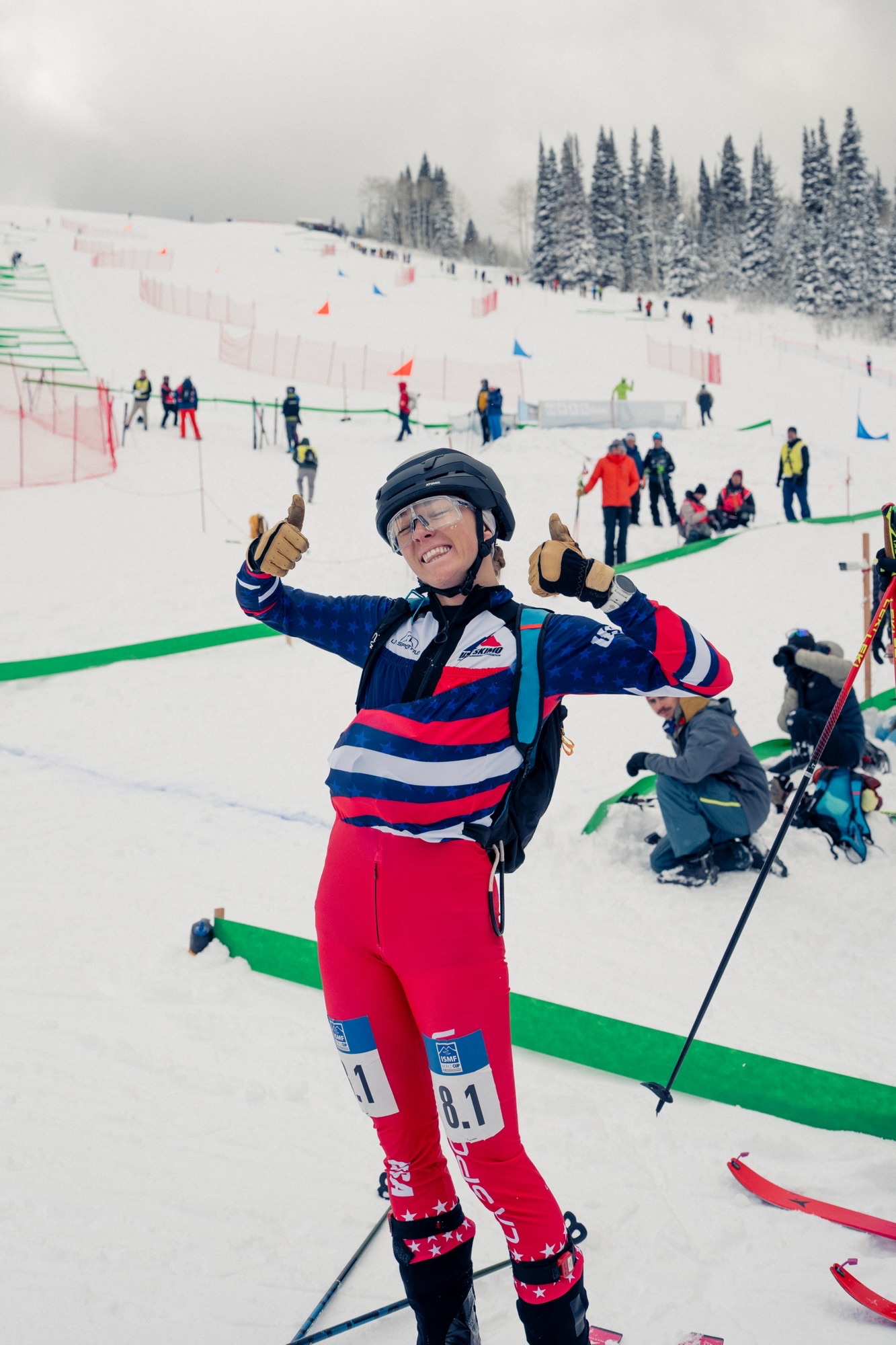
N: How important are transitions for overtakes and overall results?
A: It’s funny — I’ve done interviews with Cam and his answer is a bit different than mine because he is incredible at transitions. From his perspective, transitions are where you overtake people.
But it’s really hard to overstate how important transitions are. Even one second slower than your competitors in every transition means you’re bleeding time — and you transition a ton per lap. Over the whole race, that can be 12 to 15 seconds, which is the difference between places.
I was worried about transitions going into the race at Solitude where we qualified, and it ended up going totally fine because I have other strengths. As an ex-alpine racer, I’m comfortable skiing gates and going fast on skinny skis. I made up the most ground on the downhill.
Everyone in the race has a massive VO2 max and is an uphill animal, so I wasn’t gaining much there. Everyone has different strengths. For me, transitions are probably the weakest part, so that’s what I’ve been working on the most. The downhill skiing is probably my strongest.
N: What’s your pre-race routine? Morning-of, what does it look like?
A: When I wake up depends on the race, but I try to be awake for a few hours beforehand even if it’s early. I’ll wake up about four hours in advance at the latest.
Mostly because I like to eat three hours out. My ideal breakfast is super simple: two pieces of toast with eggs on top, plus coffee.
Then I take sodium bicarb — that’s been super key for efforts like the mixed relay or individual sprint because you go so lactic. The bicarb has been massive for me. It completely changes the sensations in your body.
Warm-up is a combination of easy skinning, doing transitions, and getting my heart rate up. Sometimes that happens on a spin bike — there are a lot of spin bikes in the team tents. People use them between relay legs, as warm-up, cool down — all of it.
N: Any special shoutouts?
A: My support system is huge.
Sponsors are a big one because they started working with me as a runner, and to allow me to explore bike racing and ski mountaineering this year has been incredible.
My coach, David Roche — he’s coached me through all of this and is coaching far beyond his personal experience, which is legendary. He’s also one of my biggest mental support systems. He’s always been in my corner.
My family — they’ve traveled around the world a handful of times this year to watch me race, and to do it again for the biggest stage ever is massive.
And a massive shoutout to everybody in Jackson — my closest friends and my community, and also anyone who’s said anything to me in the tram line or out on the mountain. That part has been the coolest part of this entire experience — feeling the excitement in this community. I’m storing it away and I’m going to take it over to Italy with me.
N: Where and when can people watch?
A: It'll be on NBC and streamed on Peacock. I’m competing in the individual sprint on February 19. I believe the livestream is at 5:30 AM MDT and there might be a recap at 6 PM. Then the mixed relay is two days later on the 21st — similar schedule.
N: One last thing: bring back the Randonée Rally?
A: Bring back the Randonée Rally! It was the first skimo race in the U.S., and it used to take place here at JHMR.
It used to literally start underneath the base of the tram. They went up the skier bridge and all over the mountain — including a literal boot pack and ladder up Corbet’s Couloir.
This is how I knew about it: I have memories of going to watch my parents do it when I was four years old.
You heard it here first. And just to clarify: ‘randonée’ was like the original name for skimo — randonée racing. Not many people use it anymore, but I think we should bring it back.
Follow Anna Gibson as she heads to Milan-Cortina, Italy for the 2026 Winter Olympic Games.
- Read Anna's Team USA Profile
- Read NBC Olympics' Article on Anna & Cam Qualifying for the 2026 Winter Olympic Games
- Read Buckrail's Article on Anna Qualifying for the Olympics
From The Blog

Layers of Time
NEW FILM: Layers of Time celebrates our 60th Anniversary through the story of our mountain’s ascent. Watch now and experience the journey.

WAFFLE BOYS
NEW FILM: Waffle Boys follows Tucker Carr, Luke & Wyatt Gentry as the seasons change. Spatulas are traded for skis, but waffle consumption remains consistent. Watch now—side effects may include intense hunger for powder turns and waffles.
Rendezvous VIP
Springtime in Jackson Hole is pure magic, and there’s no better way to welcome the season than with the Rendezvous Music Festival, a weekend of live music, adventure, and VIP luxury! Whether you’re here for the beats, the slopes, or an unforgettable getaway, the VIP experience takes it to the next level with premium perks, stunning views, and exclusive access. Tickets are limited and selling fast, so don’t miss your chance to experience Jackson Hole’s most electrifying spring event in style!

A Snowy Start to 2026 in Jackson Hole
As 2025 came to a close, skiers around the west were beginning to wonder where winter was. But the befuddled skiers of Jackson Hole were in for a quick fix and wouldn’t have to ponder their powder fate for long, because 2026 came fully equipped with a brand new bag of tricks. It's called: The Teton Trickle.

Peak Winter, Prime Skiing: Why You Should Visit Jackson Hole in January
JH Dreaming? January's the Answer.
College Spring Break
Ski. Party. Sleep. Repeat.
Read more to see why Jackson Hole is the best college spring break destination.